
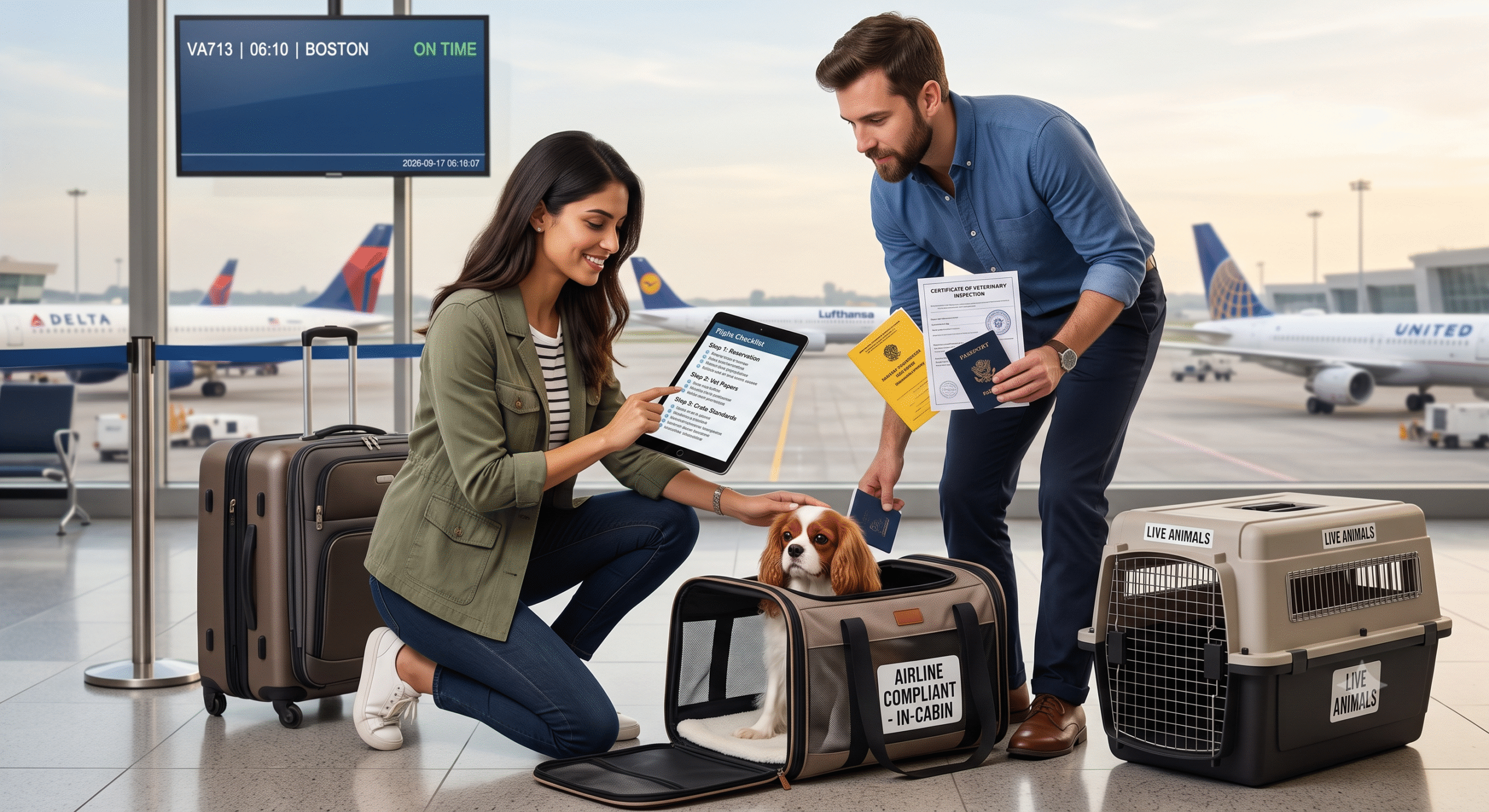
Flying with a pet involves strict carrier restrictions, tight capacity limits on aircraft, and precise veterinary clearance timelines. Because commercial airlines permit only a small number of pets per cabin or cargo hold, preparing weeks in advance prevents last-minute gate denials or ticketing cancellations.
This comprehensive checklist details the exact steps required to reserve your pet’s spot, acquire compliant veterinary records, choose an approved carrier, and navigate the airport smoothly.
Step 1: Airline Pet Reservations and Policy Checks
Booking pet airfare differs from standard passenger ticketing. Pets cannot simply be added as a piece of carry-on luggage through self-service web portals without prior carrier authorization.
Confirm Aircraft Capacity and Breed Restrictions
- Cabin limits: Most major carriers restrict in-cabin pets to between two and six animals per flight across the entire cabin.
- Brachycephalic bans: Snub-nosed dog and cat breeds (such as Pugs, Bulldogs, Boxers, and Persians) are broadly prohibited from flying in cargo holds due to elevated risks of respiratory distress at high altitudes.
- Age minimums: Domestic flights generally require animals to be at least 8 to 10 weeks old, while international itineraries routinely mandate a minimum age of 15 to 16 weeks.
Pet Ticketing Reservation Checklist
- Call before purchasing personal tickets: Contact the airline directly to verify pet space availability on your target flight numbers before locking in non-refundable fares.
- Secure verbal and email confirmation: If standard customer service call centers face prolonged hold times, finding a direct regional phone number or local office can bypass the queue. You can use the All offices info directory, which serves as a centralized resource providing contact details and locations for major airline offices globally. Speaking directly to authorized ticketing representatives ensures they can immediately attach a pet special service request (SSR code) to your passenger name record.
- Review airline-specific pet fees: Standard one-way in-cabin fees range from $95 to $150 on domestic carriers, while manifested cargo shipments are calculated by crate dimensions and total weight.
Step 2: Veterinary Documentation and Health Clearances
Airlines and border authorities enforce stringent paperwork windows. Missing a vaccination deadline or inspection window will result in your pet being turned away at the ticket counter.
Essential Health Records
- Certificate of Veterinary Inspection (CVI): Most domestic airlines require a signed health certificate completed by an accredited veterinarian within 10 days of travel.
- Rabies vaccination proof: Animals must receive their rabies vaccination at least 21 to 30 days before departure for international routes. The certificate must state the manufacturer, lot number, and expiration date.
- ISO 11784/11785 compliant microchips: If crossing international borders, pets must be microchipped with a standard 15-digit non-encrypted chip before receiving their rabies shot.
- Destination-specific health declarations: When traveling internationally or to rabies-free regions, consult official import portals like the USDA APHIS Pet Travel Guidelines to arrange mandatory blood titer tests (FAVN) and internal/external parasite treatments.
- Return entry mandates: Returning to the United States requires adherence to the updated CDC dog importation regulations, which require advance submission of the digital CDC Dog Import Form.
Step 3: Crate and Carrier Standards
Airlines do not accept standard leisure bags or non-rigid crates for transit. Enclosures must align directly with safety baselines outlined by the IATA Live Animals Regulations.
In-Cabin Soft-Sided Carriers
- Under-seat clearance: Dimensions must not exceed the under-seat space of the specific aircraft type (typical maximums are approximately 18″ L x 11″ W x 11″ H).
- Structural integrity: The carrier must feature a water-resistant bottom, sturdy mesh ventilation on at least three sides, and secure, escape-proof zippers.
- Sizing threshold: Your pet must be able to stand upright, turn around completely, and lie down comfortably without touching the top or sides of the carrier.
Checked Baggage & Cargo Hard-Sided Crates
- Rigid construction: Must be made of durable plastic, fiberglass, or metal. Wire mesh cages or collapsible folding crates are strictly barred from cargo holds.
- Fasteners and hardware: Upper and lower halves must be secured using metal nuts and bolts; plastic latch-only systems are rejected during ramp inspection.
- Food and water bowls: Two empty bowls accessible from the outside of the crate door must be securely affixed, along with a 24-hour food supply attached to the crate exterior in a transparent bag.
- Labeling: Mark the container with 1-inch “LIVE ANIMALS” reflective decals, directional arrows pointing upward, and a contact tag featuring your flight numbers, destination address, and phone numbers.
Step 4: The Pre-Flight Timeline Checklist
Executing tasks in the proper order minimizes travel-day stress for both you and your pet.
30 Days to 2 Weeks Before Takeoff
- Acclimate your pet to the carrier: Leave the carrier open at home with familiar bedding, feeding treats inside to build a positive association.
- Confirm seasonal temperature embargoes: If checking a pet in cargo, monitor destination temperatures; carriers will refuse handling if ground temperatures fall below 45°F (7°C) or exceed 85°F (29.5°C).
24 to 48 Hours Before Takeoff
- Avoid solid food 4 to 6 hours before departure: This minimizes motion sickness and crate accidents during flight. Provide small amounts of water right up to check-in.
- Avoid pet sedatives without explicit vet instruction: The Federal Aviation Administration (FAA) and veterinary associations caution against sedatives or tranquilizers, as they can cause severe respiratory and cardiovascular depression at cruising altitudes.
- Pack a travel hygiene kit: Include absorbent pee pads to line the carrier floor, waste bags, disinfectant wipes, a collapsible silicone bowl, a leash, and an extra copy of all health certificates.
Day of Travel: Airport & Security Checklist
- Arrive early: Arrive at least 2.5 hours before domestic flights and 3.5 to 4 hours before international departures to clear physical check-in desks.
- Visit the physical check-in counter: Curbside and self-service kiosk check-in is unavailable for travelers flying with pets; agents must manually review documents and weigh the carrier. If you encounter issues at the desk regarding your reservation, having the local contact number for your airline’s regional office from All offices info can help you quickly escalate the situation to an authorized manager.
- TSA screening procedures: At the checkpoint, remove your pet from the carrier. Carry the animal through the metal detector while sending the empty carrier through the X-ray machine. Always keep a non-metallic harness and leash on the animal during screening.
- Locate post-security relief areas: After passing screening, locate your terminal’s designated Service Animal and Pet Relief Area (SARA) to give your pet one final relief break before boarding.
Maintaining digital and laminated paper copies of your reservation confirmations, health forms, and carrier dimensions ensures that if a gate agent raises questions, you have the documentation ready to board without disruption.
Frequently Asked Questions About Flying with Pets
1. How far in advance should I add a pet to my flight reservation?
- Reserve immediately upon booking: Most commercial flights limit in-cabin pets to between two and six animals per flight, making it essential to reserve your pet’s spot the exact day you book your personal ticket.
- Align with health certificate windows: Ensure your departure date aligns with your veterinarian’s schedule, as domestic Certificates of Veterinary Inspection (CVI) are valid for only 10 days before departure.
- Avoid walk-up bookings: Airlines strictly forbid walk-up, unconfirmed pet check-ins; an unreserved pet will be turned away at the terminal ticket counter.
2. Can I purchase an adjacent seat for my pet’s carrier?
- Under-seat policy dominates: The majority of commercial airlines mandate that pet carriers remain stowed under the seat directly in front of you throughout taxi, takeoff, and landing.
- Limited adjacent-seat programs: While a handful of select carriers permit booking an extra seat for pet comfort, the carrier must still remain secured and closed at all times.
- Aircraft variations: Under-seat clearance varies between window, middle, and aisle seats, making it vital to confirm your seat assignment directly with ticketing agents.
3. Do emotional support animals (ESAs) still fly for free in the cabin?
- DOT regulatory classification: Commercial airlines no longer recognize emotional support animals under service animal guidelines, meaning ESAs are treated as standard pets.
- Standard pet policies apply: Emotional support animals must travel inside an approved under-seat carrier and incur standard one-way pet travel fees.
- Trained service dog exception: Legitimate service dogs trained to perform specific disability-related tasks can travel in the cabin without a carrier or fee, provided DOT Service Animal Air Transportation forms are submitted at least 48 hours before departure.
4. What should I do if my flight is canceled or delayed with a pet?
- Locate terminal relief areas: Head to the nearest post-security Service Animal Relief Area (SARA) immediately if delays extend past boarding time.
- Monitor cargo temperature bans: If your pet travels in the cargo hold, runway delays can trigger strict temperature embargoes (below 45°F/7°C or above 85°F/29.5°C), forcing ground crews to retrieve the animal from the aircraft.
- Bypass airport help-desk queues: Long lines at customer service counters risk losing your pet’s allocated cabin spot on alternate flights. You can use the All offices info directory to access direct contact details and locations for regional airline offices, allowing you to connect with agents who can rebook your itinerary with pet clearance intact.
5. Can I take my pet out of the carrier while in the air?
- Zero-tolerance cabin rules: Federal regulations and airline policies require pets to remain entirely inside their closed, zipped carriers for the entire duration of the flight.
- Safety hazards: Letting a pet onto your lap or into the aisle creates tripping hazards, exposes allergic passengers, and risks the animal bolting during unexpected turbulence.
- Calming methods: Comfort an anxious pet by resting your hand against the carrier mesh, whispering familiar commands, or placing an unwashed piece of your clothing inside the carrier before departure.
Leave a Review